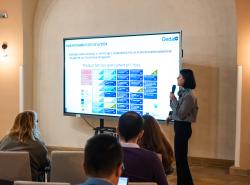
At the end of 2025, as part of the First International Conference “Standards for a Sustainable Future” and the National Annual Forum of the Bulgarian Welding Society (BSW), Dedal - Attestation and Certification organized a series of workshops on Life Cycle Assessment (LCA) calculations for the preparation of Environmental Product Declarations (EPDs) and for the implementation of the new System 3+ under the Construction Products Regulation (EU) 2024/3110.
WHAT IS AN EPD FOR CONSTRUCTION PRODUCTS?
An Environmental Product Declaration (EPD) for construction products is a standardized, third-party verified document that transparently reports a product’s environmental impacts throughout its life cycle.
An EPD is defined under the framework of:
• EN 15804 - Sustainability of construction works - Environmental product declarations - Core rules for the product category of construction products;
• ISO 14025 - Type III environmental declarations;
• ISO 14040 and ISO 14044 - Life Cycle Assessment (LCA) methodology.

HOW IS AN EPD DEVELOPED AND WHAT ARE THE MAIN STEPS?
Step 1. Define scope and select applicable PCR
→ EN 15804-based Product Category Rules (and any c-PCR, if available).
Step 2. Collect primary data from the manufacturer
→ Raw materials, energy, transport, manufacturing, waste, packaging, etc.
Step 3. Build the LCA model by an LCA practitioner
→ According to ISO 14040 / ISO 14044, using primary data and background data (for Europe, typically Ecoinvent).
Step 4. Calculate environmental impacts
→ Indicators required by EN 15804 (e.g. GWP, energy use, water use, resource consumption).
Step 5. Compile the EPD document according to the requirements of the program operator
→ Product information, technical data, LCA results, assumptions, scenarios, etc.
Step 6. Independent verification by an approved verifier
→ Mandatory for external publication according to ISO 14025.
Step 7. Registration and publication
→ Submission to an EPD Program Operator and publication on an online platform.
Step 8. Validity and update
→ Typically valid for 5 years; review and update when necessary.

WHAT IS THE NEW SYSTEM 3+ AND HOW IS IT DIFFERENT FROM AN EPD?
A new AVCP/AVS System 3+ has been introduced under the new Construction Products Regulation (EU) 2024/3110. It will become mandatory for construction products once the relevant harmonized technical specification is published in the Official Journal (OJ) of the European Union.
Under the new CPR, harmonized standards are expected to include environmental sustainability characteristics to be assessed under System 3+, with the results declared in the manufacturer’s CE Declaration of Performance (DoP).
This means that construction products placed on the EU market will need to be assessed under System 3+ for environmental performance once the revised harmonized standard becomes applicable.

HOW IS DEDAL POSITIONED IN THE CONTEXT OF EPD AND THE NEW SYSTEM 3+ REQUIREMENTS?
Dedal is a Notified Body (No. 1922) to the European Commission for CE certification of construction products and an IAF-accredited certification body for EPD process, approved by the International EPD System (IES). We specialize in CE certification, EPD verification and LCA consultancy for construction products under the CPR, supporting clients in over 60 countries worldwide.