Certification process
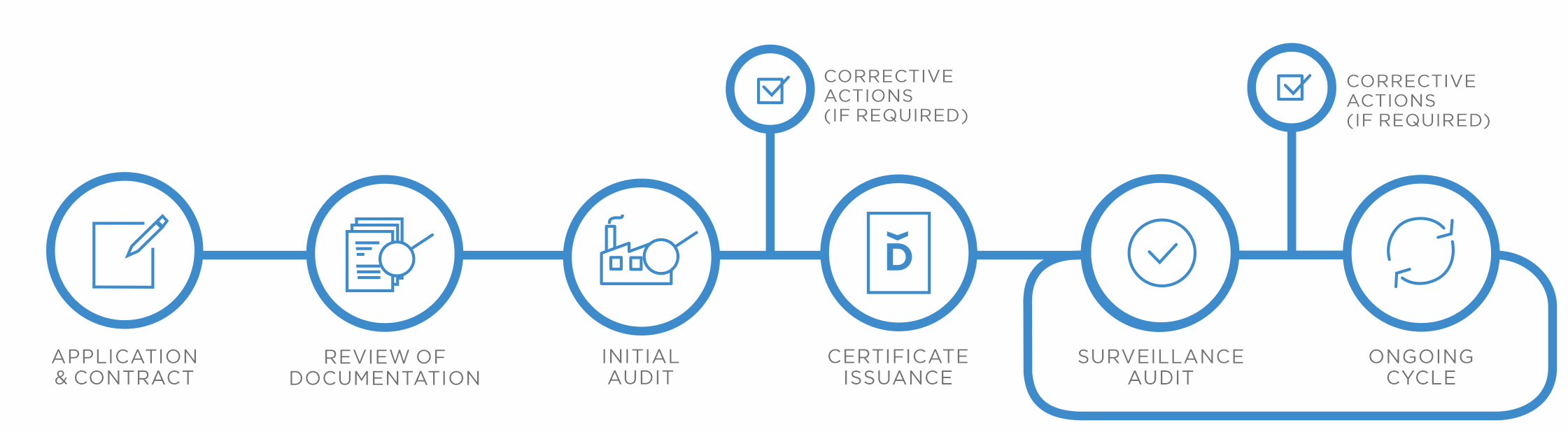
The certification process may vary depending on the certification scheme applied. The scheme documents, including the criteria and process to be used in assessing conformity, will be provided by the certification body upon request. Underneath you can find a general description of the conformity assessment schemes.
 Keeping the technical documentation for a defined period after the construction product has been placed on the market.
 Keeping a register of all complaints about non-conformance or product recalls, inform distributers of any product recalls.
 Adherence to specific marking requirements.
 Supplying instructions and safety information in the language of the member state in which the product is being sold.
 Immediate corrective measures if a product is not in conformity.
- Certification in the Voluntary (Non-Regulated)
-
The Product Certification Body performs voluntary product certification in the non-regulated field in accordance with the applicable product standards, technical specifications and certification schemes.
Where voluntary certification is requested in accordance with a European standard harmonised under Regulation (EU) No 305/2011, for purposes outside the scope of Regulation (EU) No 305/2011, the conformity assessment is carried out against the technical requirements of the relevant product standard, without application of Annex ZA and without reference to the Assessment and Verification of Constancy of Performance (AVCP) procedures laid down in Regulation (EU) No 305/2011.
The issued Certificate of Conformity confirms that the product complies with the technical requirements specified in the applicable technical specification solely for the purposes of voluntary product certification.Limitations in the case of Voluntary Product Certification
When carrying out voluntary product certification of construction products in the non-regulated field, the Product Certification Body applies appropriate measures to prevent any risk of misleading users of certification.
Accordingly:
- voluntary product certification does not replace the Assessment and Verification of Constancy of Performance (AVCP) in accordance with Regulation (EU) No 305/2011;
- the issued certificate is not a Certificate of Constancy of Performance and does not provide a basis for drawing up a Declaration of Performance (DoP) or for affixing the CE marking;
- voluntary product certification shall not be used in any manner that creates the impression that the product has been assessed as a construction product under Regulation (EU) No 305/2011 where this is not applicable;
- the certificate confirms only the conformity of the product with the technical specification identified in the certificate and within the scope defined by the Product Certification Body;
- The certification scheme is intended for global application wherever it is applicable and where there is demand from the Certification Body's clients.
- In cases (geographical areas, e.g. the territory of the European Union and other territories where Regulation (EU) No 305/2011 is mandatory), where certification is performed against standards harmonised under Regulation (EU) No 305/2011 and the intended use of the product requires the issuance of a Declaration of Performance (DoP), certificates of conformity issued under the voluntary (non-regulated) certification scheme shall not replace certificates issued by a Notified Body under Regulation (EU) No 305/2011 where the assessment and verification system specified in Annex ZA of the relevant harmonised standard requires the involvement of a Notified Body, and such certificates shall not be used for that purpose.
In accordance with the requirements of Chapter III of Regulation (EU) No 305/2011, responsibility for the content and accuracy of the documentation, as well as the obligation to issue the documents required for placing the product on the market, rests solely with the person placing the product on the market.
Use of the Certification Body Logo
The logo of the Product Certification Body may be used only by holders of a valid certificate and only in relation to products covered by the scope of the certificate.
The logo shall be used in accordance with the conditions established by the Product Certification Body. The following is not permitted:- use of the logo on products that are not covered by certification;
- use of the logo in a manner that may be confused with the CE marking;
- use of the logo following the suspension, restriction, termination or withdrawal of the certificate;
- use of the logo in a manner that creates a false or misleading impression regarding the scope or nature of the certification.
Where unauthorized or improper use of the logo is identified, the Product Certification Body shall take appropriate action in accordance with its certification procedures and the conditions of the certification agreement.
Reference to the Certification
The certificate holder may refer to the certification only in a manner that is accurate, unambiguous and not misleading.
The certificate or any reference to it shall not be used in a manner that:- creates the impression that products outside the scope of the issued certificate are certified;
- creates the impression that the certificate is a document issued under Regulation (EU) No 305/2011;
- may lead to confusion between voluntary product certification and conformity assessment in the regulated field;
- misrepresents the scope, validity or content of the certification.
In the event of restriction, suspension or withdrawal of the certificate, the certificate holder shall immediately cease all references to the certification that imply the existence of a valid certificate.
- Voluntary Certification - Scheme 6
-
Certification Scheme Type 6 is applicable to products in the non-regulated (voluntary) field of product certification or where the client requests independent certification of the product's conformity with the requirements of the applicable technical specification.
The certification process includes the following main stages:- submission of an application and review of the submitted documentation;
- assessment of the Factory Production Control (FPC) documentation;
- review of the results of the determination of the product type;
- initial audit of the manufacturing process and the Factory Production Control (FPC);
- independent certification decision;
- issuance of a Certificate of Conformity;
- periodic surveillance to confirm the continued effective implementation of the Factory Production Control (FPC).
During the initial and surveillance audits, the effectiveness of the Factory Production Control (FPC) is assessed, including the organisation of production, incoming inspection, manufacturing processes, testing activities, product traceability, management of measuring equipment, control of nonconforming products, documented information, personnel competence, internal audits and corrective actions.
The issued Certificate of Conformity confirms that the product complies with the requirements of the applicable technical specification and remains valid provided that the Factory Production Control continues to operate effectively and the results of the surveillance activities confirm continued conformity.
Voluntary certification under Certification Scheme Type 6 does not constitute Assessment and Verification of Constancy of Performance (AVCP) in accordance with Regulation (EU) No 305/2011, may not be used as the basis for drawing up a Declaration of Performance (DoP), and does not entitle the manufacturer to affix the CE marking.
The certificate holder may refer to the certification only in a manner that does not create a misleading impression regarding its scope. The Certificate of Conformity and the certification mark shall be used only in accordance with the rules established by the Product Certification Body. - Voluntary Certification - Schemes 7 and 8
-
Voluntary product certification is an independent conformity assessment process for construction products against the requirements of the applicable technical specifications. The objective of certification is to provide independent confirmation that the product and the factory production control consistently ensure conformity with the specified technical requirements. Voluntary certification under Certification Schemes Type 7 and 8 does not constitute Assessment and Verification of Constancy of Performance (AVCP) in accordance with Regulation (EU) No 305/2011, may not be used as the basis for drawing up a Declaration of Performance (DoP), and does not entitle the manufacturer to affix the CE marking.
The certificate holder may refer to the certification only in a manner that does not create a misleading impression regarding its scope. The Certificate of Conformity and the certification mark shall be used only in accordance with the rules established by the Product Certification Body.Certification Process - the certification process comprises the following main stages:
- submission of an application and review of the submitted documentation;
- determination of the product type by means of testing, calculations, tabulated values or descriptive product documentation, in accordance with the applicable technical specification;
- initial assessment of the factory production control through an audit of the manufacturing facility;
- review and evaluation of the test results and audit findings;
- independent certification decision;
- issuance of a Certificate of Conformity;
- periodic surveillance to confirm the continued conformity of the certified product.
During the initial and surveillance audits, the effectiveness of the factory production control is assessed, including the organisation of production, incoming inspection of raw materials, in-process and final product testing, product identification and traceability, management of measuring equipment, control of nonconforming products, personnel competence, documented information, internal audits and implementation of corrective actions.
Certification Scheme Type 7 includes:
- determination of the product type;
- initial audit of the manufacturing process and factory production control;
- issuance of a certificate following a positive conformity assessment;
- periodic surveillance of the factory production control to confirm the continued conformity of the product.
Certification Scheme Type 8 includes all activities covered by Certification Scheme Type 7, together with additional audit testing of samples taken from the manufacturing plant, the market or the construction site during surveillance, where required by the applicable technical specification.
Maintaining the Validity of the Certificate
The validity of the issued certificate is maintained through periodic surveillance. During surveillance activities, it is verified that the factory production control continues to ensure conformity of the product with the applicable technical specifications and that no changes have occurred which could affect the product characteristics.
Where nonconformities are identified, the Certification Body may require corrective actions, perform additional assessments, restrict, suspend or withdraw the issued certificate in accordance with the applicable certification rules. - Voluntary Certification - Scheme Type 1a
-
Certification Scheme Type 1a is an independent process for assessing and confirming the conformity of products, processes, or product groups with predefined technical requirements, standards, or other applicable specifications. Its primary objective is to provide objective and impartial confirmation that a product or process complies with the specified requirements at the time of assessment. The scheme is particularly suitable for products and processes requiring a one-time independent confirmation of conformity with defined technical criteria.
The certification process begins with the submission of an application by the manufacturer or applicant, accompanied by the necessary technical documentation identifying the product or process, together with the applicable technical specifications and any other documents required for the assessment. Following a review of the submitted documentation, its completeness and compliance with the specified requirements are verified, as well as the Certification Body's capability to perform the assessment. Where the outcome is satisfactory, a certification agreement is concluded.
The assessment includes a detailed review of the technical documentation, analysis of the submitted calculations and supporting evidence, and the performance of any required testing, measurements, inspections, or observations in accordance with the applicable technical specification. Where necessary, product samples are taken and tested by competent laboratories or inspection bodies, and the results are used to verify conformity with the specified requirements.
Upon completion of the assessment activities, the experts prepare the necessary reports and assessment records, which are subject to an independent review by a person who has not participated in the assessment itself. Based on the complete evaluation results, a decision is made to issue or refuse a certificate or conformity assessment report.
The issued certificate confirms the conformity of the specific product, process, or product group with the applicable technical requirements and includes information on the manufacturer, production facility, product or process identification, applicable technical specifications, and the validity period, where applicable.
Where non-conformities are identified during the assessment, the applicant is informed and given the opportunity to implement appropriate corrective actions before the final certification decision is taken. All assessment results are documented and retained as objective evidence of the conformity assessment.
Certification Scheme Type 1a provides independent and competent confirmation of the conformity of a product or process at the time of assessment, offering reliable evidence that the specified technical requirements have been fulfilled.
- Voluntary Certification - Scheme Type 3
-
Certification Scheme Type 3 is applicable to the voluntary certification of products in the non-regulated field. The purpose of the certification is to provide independent confirmation that the product complies with the requirements of the applicable technical specification and that the Factory Production Control (FPC) ensures the consistent maintenance of its characteristics.
Certification Process:
The certification process includes the following main stages:
- submission of an application and review of the submitted documentation;
- assessment of the product technical documentation and the Factory Production Control (FPC) documentation;
- initial audit of the manufacturing process and the Factory Production Control (FPC);
- audit testing of product samples, where applicable;
- independent review of the assessment results;
- certification decision;
- issuance of a Certificate of Conformity;
- periodic surveillance to confirm the continued conformity of the certified product.
During the initial and surveillance audits, the effectiveness of the Factory Production Control (FPC) is assessed, including the organisation of production, incoming inspection of raw materials, manufacturing processes, in-process and final product testing, product traceability, management of measuring equipment, control of nonconforming products, documented information, internal audits, corrective actions and personnel competence.
Audit Testing:
As part of the surveillance activities, the Product Certification Body carries out audit testing of product samples taken from the production. The testing is performed by competent laboratories to verify that the certified product continues to comply with the requirements of the applicable technical specification.Maintaining the Validity of the Certificate:
The validity of the issued certificate is maintained through periodic surveillance. During surveillance activities, it is verified that the Factory Production Control (FPC) continues to operate effectively, that the product characteristics are consistently maintained, and that no changes have occurred which could affect conformity.
Where nonconformities are identified, the Product Certification Body may require corrective actions, carry out additional assessments or audit testing, or decide to restrict, suspend or withdraw the issued certificate in accordance with the applicable certification rules.Voluntary Product Certification:
Certification Scheme Type 3 is applied in the voluntary (non-regulated) field of product certification. The issued Certificate of Conformity confirms the conformity of the product with the requirements of the applicable technical specification solely for the purposes of voluntary product certification and shall not be used in a manner that creates the impression that the product has been assessed under a regulated conformity assessment system.Reference to Certification:
The certificate holder may refer to the certification only in a manner that is accurate, unambiguous and does not create a misleading impression regarding the scope of the certificate or the certified product.Use of the Product Certification Body Logo:
The logo of the Product Certification Body may be used only by holders of a valid certificate and solely under the conditions established by the Product Certification Body. The logo shall not be used in a manner that creates a false or misleading impression regarding the scope or nature of the certification